Choosing an audio interface with MADI is less about collecting the most inputs and more about matching digital I/O, routing, drivers, and expansion to your workflow.
These 10 selections cover portable MADI connections, PCIe systems, dedicated converters, networked audio, and hybrid interfaces for studios and live production.
Best 10 Audio Interface with Madi Picks for 2026
Best Compact MADI Interface

- USB 2.0 connection for Mac and Windows
- Optical and coaxial MADI I/O
- 64 channels at up to 192 kHz
Best For: Compact computer-based MADI recording systems
Best MADI Expansion Module
2nd MADI I/O Module, Multimode

- Expands compatible Horus systems
- Up to 128 inputs and 128 outputs at 1FS
- Can add MADI to a Hapi
Best For: Horus and Hapi system expansion
Best High-Channel USB MADI Interface

- 394-channel USB 3.0 interface
- Two optical and one coaxial MADI port
- Includes mic/line, analog, and headphone I/O
Best For: Large DAW-based recording and routing systems
Best PCIe MADI Card

- 390-channel PCI Express design
- Three MADI I/O connections
- Adds AES/EBU and virtual MIDI I/O
Best For: High-capacity desktop workstation systems
Best Overall

- 94-in/94-out USB 3.0 interface
- ADAT and AES/EBU digital I/O
- Four mic/line preamps with DSP
Best For: Large studio setups needing extensive USB and digital I/O
Best for MADI Expansion

- 16-channel MADI-to-ADAT package
- Expandable to 64 channels
- 24-bit/48 kHz MADI, ADAT, and myMix support
Best For: Console and myMix systems requiring scalable MADI channel expansion
Best Portable Option

- Bus-powered optical interface
- Four optical inputs and outputs
- 32-in/32-out operation up to 192 kHz
Best For: Portable ADAT or S/PDIF routing with computers and mobile devices
Best with Extra Features
MOTU 10pre 26x28 Thunderbolt 4/USB4 Interface
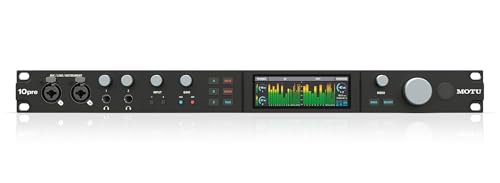
- 54 simultaneous channels with dual 8-channel optical I/O
- Thunderbolt 4/USB4 connectivity and low reported latency
- ESS Sabre32 conversion, DSP mixing, and AVB networking
Best For: Large or expandable studio recording systems
Best for Dante Conferencing
Shure ANIUSB-MATRIX Network Interface

- Dante interface with USB and PoE support
- 3-pin input and output connections
- Designed for Windows conferencing software
Best For: Dante-enabled audio/video conferencing installations
Best Compact USB Option
MOTU UltraLite-mk5 USB-C Interface Bundle

- 18 inputs and 22 outputs with ADAT and S/PDIF
- USB-C, MIDI I/O, loopback, and CueMix 5 control
- Includes a 10-foot XLR cable and setup accessories
Best For: Compact recording, streaming, and digital-expansion setups
Best Compact MADI Interface – RME MADIface USB
The RME MADIface is a practical choice when you need an audio interface with MADI in a compact USB 2.0 format. It provides optical and coaxial MADI I/O, supports up to 64 channels and 192 kHz operation, and includes TotalMix FX management software for compatible Mac and Windows setups.
Best For: Computer-based recording systems that need dual MADI connectivity without a larger rack-style interface.
Pros:
- Includes both optical and coaxial MADI I/O.
- Supports up to 64 channels and 192 kHz sample rates.
- Works with Mac and Windows computers through USB 2.0.
- Includes TotalMix FX management software.
Cons:
- USB 2.0 is less current than the USB 3.0 connection on some newer models.
- Its listed channel count is lower than the 390- and 394-channel alternatives.
Choose the MADIface when portability and straightforward USB connectivity matter more than extensive analog I/O or maximum channel capacity.
Best MADI Expansion Module – 2nd MADI I/O Module, Multimode
This multimode MADI expansion module is designed for compatible Horus and Hapi systems rather than standalone computer recording. It can double a Horus system’s MADI capacity to 128 inputs and 128 outputs at 1FS, or add a MADI connection to a Hapi.
Best For: Expanding the MADI connectivity of compatible Horus or Hapi hardware installations.
Pros:
- Can expand a Horus system to 128 inputs and 128 outputs at 1FS.
- Can add a MADI connection to a Hapi.
- Uses a multimode MADI configuration.
Cons:
- It is an expansion module, not a standalone audio interface with MADI.
- Compatibility is specifically centered on Horus and Hapi systems.
- The supplied notes list Windows support but do not specify broader operating-system compatibility.
This module makes sense only when you already use compatible Horus or Hapi equipment and need additional MADI capacity or connectivity.
Best High-Channel USB MADI Interface – RME MADIface XT II
The RME MADIface XT II is a versatile audio interface with MADI for demanding studio and DAW systems. Its USB 3.0 connection, two mic/line inputs, coaxial and dual optical MADI ports, analog outputs, headphone output, and 394-channel specification suit large digital routing setups on Linux, Windows, and macOS.
Best For: High-channel-count recording and routing systems that also need a small amount of direct analog and headphone connectivity.
Pros:
- Offers 394 channels with operation up to 192 kHz.
- Provides one coaxial and two optical MADI ports.
- Includes two mic/line inputs, two analog outputs, and a headphone output.
- Supports Linux, Windows, and macOS through USB 3.0.
Cons:
- At 5 pounds, it is heavier than the compact MADIface model.
- Its extensive channel capacity may exceed the needs of smaller systems.
- The supplied specifications list a 1-ohm impedance, which may require careful system matching.
The XT II is the stronger fit for users who want substantial MADI capacity plus practical analog monitoring and input options in one USB-connected unit.
Best PCIe MADI Card – HDSPe MADI FX
The HDSPe MADI FX is a PCI Express audio interface with MADI built for desktop workstations. It delivers 390 channels through three MADI connections—two optical and one coaxial—along with AES/EBU I/O via breakout cable and three virtual MIDI I/O connections over MADI.
Best For: Windows, macOS, or Linux desktop workstations requiring high-capacity PCIe MADI connectivity.
Pros:
- Provides 390 total channels, with 194 inputs and 196 outputs.
- Includes three MADI I/O connections: two optical and one coaxial.
- Adds AES/EBU I/O through a breakout cable.
- Supports three virtual MIDI I/O connections over MADI.
Cons:
- PCI Express installation requires a compatible desktop computer.
- It is not designed as a portable USB interface for laptops.
- AES/EBU connectivity requires the supplied-style breakout-cable setup.
For a fixed desktop system, the MADI FX stands out when maximum channel density, multiple MADI links, and PCIe performance are more important than portability.
Best Overall – RME Fireface UFX III
The RME Fireface UFX III is a powerful choice for buyers seeking an audio interface with MADI in a larger computer-based recording setup. It combines USB 3.0 connectivity with ADAT and AES/EBU digital I/O, four mic/line preamps, onboard DSP effects, and direct USB recording.
Best For: Studio users who need extensive I/O, multiple digital connection options, and high-resolution recording up to 192 kHz.
Pros:
- 94-in/94-out USB 3.0 design for large routing needs
- Includes ADAT and AES/EBU digital I/O
- Four integrated mic/line preamps
- DSP effects and direct USB recording
Cons:
- Its extensive features may be more than a simple recording setup requires
- The supplied notes do not specify built-in MADI ports
The UFX III stands out for its broad channel count and flexible digital expansion. However, buyers specifically requiring onboard MADI should confirm the connection options before purchasing.
Best for MADI Expansion – MADI-16 16-Channel Interface
The MADI-16 is a focused solution for expanding a console-based system with an audio interface with MADI capability. It combines an IEX16L-A with the RME ADI-648 MADI-to-ADAT interface, supporting 16 channels and scalable expansion up to 64 channels with additional IEX16L-A units.
Best For: Users moving more than 16 console channels through MADI into a myMix-based system.
Pros:
- Designed specifically for 16-channel MADI integration
- Can scale to a maximum of 64 channels
- Supports MADI, ADAT, and myMix at 24-bit/48 kHz
- Does not require an external master clock for the described setup
Cons:
- Limited to 24-bit/48 kHz signals
- Additional IEX16L-A units are needed for expansion beyond 16 channels
- Setup may require TOSLINK cables and network hardware for larger systems
Unlike a general-purpose USB interface, the MADI-16 is purpose-built for channel expansion and myMix integration. Its fixed 48 kHz workflow makes it best suited to compatible live or installed systems.
Best Portable Option – RME Digiface USB
The RME Digiface USB is a compact option for building an audio interface with MADI-style digital routing around optical connections. It provides four optical inputs and outputs, 32-in/32-out operation, USB connectivity, and bus-powered portability for Mac and PC systems.
Best For: Mobile and desktop users who need portable optical ADAT or S/PDIF routing at sample rates up to 192 kHz.
Pros:
- Portable, bus-powered digital interface
- Four optical inputs and outputs
- Supports up to 32 inputs and 32 outputs
- Works with computers, tablets, and smartphones
Cons:
- Provides digital I/O rather than built-in mic preamps
- The supplied notes list ADAT and S/PDIF support, not native MADI connectivity
- USB connection is required for operation
The Digiface USB is a practical travel-friendly digital hub, especially when optical ADAT or S/PDIF connections are the priority. Buyers seeking native MADI should verify compatibility with their specific MADI hardware.
Best with Extra Features – MOTU 10pre 26×28 Thunderbolt 4/USB4 Interface
MOTU 10pre 26x28 Thunderbolt 4/USB4 audio interface for Mac, Windows and iOS with 10 mic inputs
Check Price On AmazonThe MOTU 10pre is a strong choice if you need an audio interface with MADI-style digital expansion capabilities, extensive I/O, and fast computer connectivity. Its two banks of 8-channel optical I/O, 10 mic/line/instrument inputs, and 54 simultaneous channels make it suitable for larger recording and mixing setups.
Best For: Studios needing high channel capacity, optical digital I/O, low latency, and flexible routing.
Pros:
- 26 inputs and 28 outputs with dual banks of 8-channel optical I/O
- Thunderbolt 4/USB4 connectivity with up to 256 audio channels depending on the host
- High-quality ESS Sabre32 converters with 125 dB dynamic range
- Built-in DSP mixing, effects, AVB networking, and detailed front-panel metering
Cons:
- Its broad feature set may be more than a small home setup requires
- Lightning iPad connectivity requires a separately sold adapter kit
The 10pre stands out for demanding sessions where optical expansion, network audio, and low-latency performance matter. It is a particularly capable option for users building a scalable studio system around MOTU’s AVB ecosystem.
Best for Dante Conferencing – Shure ANIUSB-MATRIX Network Interface
The Shure ANIUSB-MATRIX is a compact network audio interface for systems that use Dante and USB-based conferencing. With 3-pin input and output connections, USB, and PoE support, it is a focused option for integrating computer audio with a Dante audio network rather than a traditional multichannel recording rig.
Best For: Windows-based audio/video conferencing systems that need Dante network integration.
Pros:
- Combines Dante networking with USB connectivity
- Includes 3-pin input and output connections
- PoE support can simplify power and installation
Cons:
- Designed around conferencing and network audio rather than broad studio recording
- Windows is the listed operating system
- Its seven-channel specification is less expansive than full-size recording interfaces
The ANIUSB-MATRIX makes the most sense when Dante compatibility is the priority. It is a specialized installation-oriented choice for connecting a Windows computer to a networked audio system, not a general-purpose interface for many microphone inputs.
Best Compact USB Option – MOTU UltraLite-mk5 USB-C Interface Bundle
The MOTU UltraLite-mk5 bundle is a practical USB-C interface for musicians, producers, and creators who need flexible routing in a smaller setup. Although it is not a dedicated MADI interface, its optical ADAT, coaxial S/PDIF, MIDI I/O, and 18-in/22-out configuration provide useful digital expansion and connectivity.
Best For: Compact production, podcasting, livestreaming, and setups requiring multiple digital connection formats.
Pros:
- 18 inputs and 22 outputs with ADAT, S/PDIF, and MIDI I/O
- 10 DC-coupled line outputs for flexible routing and hardware integration
- Upgraded mic preamps provide up to +74 dB of gain
- Includes loopback channels, OLED metering, CueMix 5, and useful bundle accessories
Cons:
- Does not list MADI connectivity
- Fewer inputs and outputs than the MOTU 10pre
- The included accessories add convenience but may not be essential for every buyer
The UltraLite-mk5 is a versatile alternative when USB-C convenience and compact routing are more important than MADI specifically. Its optical and coaxial digital I/O make it adaptable, while loopback and CueMix 5 support creator-focused workflows.
How We Picked the Best Audio Interface with Madi
We selected products based on MADI connectivity, channel capacity, connection type, driver and platform support, routing flexibility, and suitability for studio, broadcast, installation, and live-sound use. The list includes complete interfaces, PCIe cards, expansion modules, and related digital audio hardware because MADI systems are often built from multiple components rather than one all-in-one box.
We also considered practical factors such as portability, analog I/O, computer connectivity, clocking, and whether a product is best used as a core interface or as an expansion point in a larger system.
Quick Comparison
| Best For | Recommended Type | What to Prioritize |
|---|---|---|
| Portable digital rigs | USB MADI interface | Bus power, compact design, stable drivers |
| Large studio systems | PCIe MADI card or high-I/O interface | Low latency, channel count, routing |
| Hybrid analog/digital recording | Interface with analog preamps and MADI | Analog inputs, conversion, expansion |
| Broadcast and installed audio | Dedicated MADI or network interface | Redundancy, clocking, integration |
Key Buying Factors for an Audio Interface with Madi
MADI Format and Connection
Check whether the device uses optical, coaxial, or both MADI formats. Optical connections are common for long studio and stage runs, while coaxial MADI may fit existing racks and patch systems. Confirm the supported channel count and sample-rate behavior, since higher sample rates can reduce the number of available channels.
Computer Connection and Latency
USB, Thunderbolt, and PCIe each serve different setups. USB is flexible and portable, Thunderbolt can provide high-bandwidth desktop connectivity, and PCIe is often preferred for permanent studio systems requiring very low latency. Verify operating-system compatibility and current driver support before buying.
Analog I/O and Expansion
MADI carries digital audio, so determine how many analog inputs and outputs you actually need. A compact MADI interface may require external preamps or converters, while a hybrid unit can combine microphone inputs, line I/O, monitoring, and digital expansion in one chassis.
Clocking and Routing
Reliable clock synchronization is essential when connecting multiple converters or interfaces. Look for word-clock support, flexible internal routing, and a mature control application. Loop-through, redundant connections, and onboard mixing can be especially valuable for live and broadcast systems.
Who Should Buy Which Audio Interface with Madi?
Choose a portable USB MADI interface if you move between rooms, racks, or venues and primarily need dependable digital connectivity. A PCIe MADI card is better for a fixed workstation with extensive external converters and demanding low-latency monitoring. Select a full-featured hybrid interface if you need microphone preamps, analog monitoring, and MADI expansion from the same unit.
Dedicated MADI modules suit users expanding an existing converter or console system, while network audio interfaces are a strong fit for installations that already rely on Dante or other managed audio networks. Before ordering, map every source, destination, sample rate, connector, and computer port in your system; that simple checklist prevents most compatibility problems.