The right vise can make automotive repairs safer, faster, and more precise by holding parts securely while you cut, bend, press, or assemble them. The best choice depends on your available bench space, required clamping strength, and the size of parts you typically handle.
We selected 10 bench vises spanning compact home-garage models, heavy-duty workshop designs, articulating options, and a portable hitch-mounted vise. Use the guide below to match jaw capacity, construction, mounting style, and versatility to your workload.
Best 10 Bench Vises for Automotive Work Picks for 2026
Heavy-Duty Shop Pick
Wilton Mechanics Bench Vise 746

- 6-inch jaws with a 5-3/4-inch opening
- 360° swivel base with double lockdowns
- 30,000 PSI cast-iron construction
Best For: Permanent garage and professional shop work
Portable Automotive Pick
Stark USA 2-in-1 Tow Hitch Vise

- Mounts to a bench or 2-inch hitch receiver
- 6-inch jaws for varied workpieces
- Steel construction for mobile repairs
Best For: Roadside, outdoor, and job-site automotive work
Compact Home Garage Pick

- 4.5-inch jaws open to 3 inches
- 240° swivel head with anvil surface
- Compact 9-pound home-workshop design
Best For: Light-duty home garage repairs and projects
Multi-Angle Repair Pick
IQ Vise 360° Articulating Bench Vice

- 360° ball-and-socket articulation
- Eight locking positions up to 130 ft-lbs
- 5-inch jaws with interchangeable pads
Best For: Detailed repairs requiring frequent angle changes
Heavy-Duty Classic

- 6-inch jaws and 6-inch opening for larger work
- 72,000 PSI ductile-iron construction
- Large anvil with 3.75-inch throat depth
Best For: Larger automotive parts, pipe, and forming work
Flexible Shop Workhorse
VEVOR 6-Inch Swivel Bench Vise

- 360-degree swivel locking base
- 6-inch jaws with up to 4,496 pounds of clamping force
- Handles flat stock and 0.6- to 2.9-inch pipe
Best For: Adjustable, multipurpose automotive bench work
Compact Utility Pick

- 240-degree swivel locking base
- Multi-jaw design holds flat stock and pipe
- Up to 2,204 pounds of clamping force
Best For: Home garages and smaller automotive workbenches
Heavy-Duty Automotive Workhorse

- 6,744-pound clamping force
- 8-inch forward and 11.5-inch reverse openings
- 360-degree swivel base with pipe jaws
Best For: Large automotive parts, pipe work, and heavy-duty garage tasks
Compact Workshop Choice
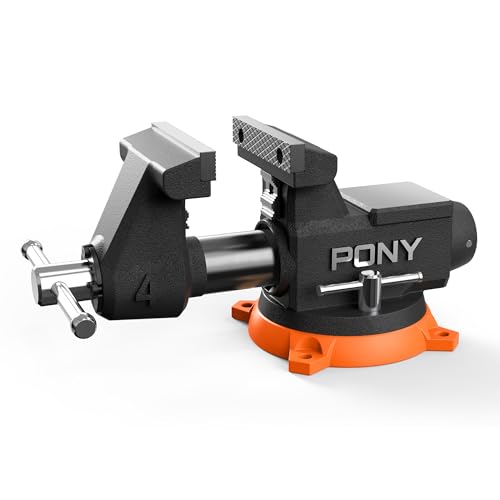
- 4,400-pound clamping force
- 360-degree swivel base
- Pipe jaws and integrated anvil
Best For: Compact garages and smaller automotive repair tasks
Versatile Mid-Size Pick

- 4,496-pound clamping force
- 6.5-inch forward and 9.3-inch reverse openings
- 360-degree swivel base with replaceable jaws
Best For: General automotive repairs and mixed flat or pipe work
Heavy-Duty Shop Pick – Wilton Mechanics Bench Vise 746
Wilton Mechanics Bench Vise, 6" Jaw Width, 5-3/4" Jaw Opening, 4-1/8" Throat (Model 746)
Check Price On AmazonFor demanding automotive work, the Wilton Model 746 is a substantial bench vise with 6-inch jaws, a 5-3/4-inch opening, and a 4-1/8-inch throat. Its 360-degree swivel base and heavy cast-iron construction make it a strong choice for a permanently mounted garage or shop setup.
Best For: Mechanics who need a rugged, full-size vise for heavy clamping, pipe work, and general automotive repairs.
Pros:
- 30,000 PSI gray cast-iron construction is designed for rugged use.
- 360-degree swivel base includes double lockdowns for stability.
- Replaceable hardened-steel top and pipe jaws add versatility.
- Large anvil surface and fully enclosed spindle support shop use.
Cons:
- At 64 pounds, it is not suited to portable work.
- Requires a sturdy workbench and appropriate mounting space.
The Model 746 prioritizes durability and stability over portability. It is a practical long-term investment for an automotive workspace where heavy-duty clamping is a regular requirement.
Portable Automotive Pick – Stark USA 2-in-1 Tow Hitch Vise
The Stark USA 2-in-1 vise brings bench-style clamping to mobile automotive work. Its 6-inch jaws mount either to a workbench or a standard 2-inch truck or trailer hitch receiver, making it useful when repairs happen away from a permanent shop.
Best For: Mobile mechanics, contractors, farmers, and DIY users who need a portable vise for vehicle and equipment repairs.
Pros:
- Dual hitch and bench mounting supports stationary or mobile use.
- 6-inch jaws hold pipes, bars, lumber, and other workpieces.
- Heavy-duty steel body is suited to demanding repair applications.
- Useful for roadside maintenance and outdoor work.
Cons:
- Requires a compatible standard 2-inch hitch receiver for mobile use.
- Its 29-pound weight is portable but still substantial to transport.
This is a flexible option for automotive work that does not always happen at a workbench. Choose it when hitch mounting and job-site portability matter as much as conventional bench use.
Compact Home Garage Pick – Yost LV-4 Homeowner's Vise
The Yost LV-4 is a compact bench vise for home workshops and lighter automotive tasks. Its 4.5-inch jaws open 3 inches, while the 240-degree swivel head and integrated anvil provide useful positioning and support in a garage workspace.
Best For: Home mechanics who want a manageable vise for general repairs, small parts, and occasional automotive projects.
Pros:
- 30,000 PSI gray-iron castings provide a sturdy foundation.
- 240-degree swivel head helps position work comfortably.
- 3-inch jaw opening and pipe capacity up to 1.85 inches support varied tasks.
- Integrated anvil offers a useful secondary work surface.
Cons:
- Mounting hardware is not included.
- Smaller jaws and opening are less suitable for oversized workpieces.
- At 9 pounds, it is lighter-duty than a large professional mechanics vise.
The LV-4 balances useful capacity with a compact footprint and manageable weight. It makes sense for a home garage where space and budget are important, provided it is securely mounted before use.
Multi-Angle Repair Pick – IQ Vise 360° Articulating Bench Vice
The IQ Vise is designed for automotive work where positioning is as important as clamping. Its articulating ball-and-socket mechanism rotates, tilts, and swivels the workpiece, while the quick cam lever and locking pin help secure the selected angle.
Best For: Repairers who frequently need multi-angle access for filing, drilling, sawing, wrenching, and detailed bench work.
Pros:
- 360-degree articulation enables flexible workpiece positioning.
- Eight locking positions are rated to 130 ft-lbs of torque.
- 5-inch parallel jaws include swap-in Flex-Fit pads.
- Hardened steel and cast-aluminum construction bolts to a workbench.
Cons:
- Additional Sure-Fit or leather jaws are sold separately.
- Optional work light, magnifier, and phone-holder accessories are not included.
- The articulating design may be unnecessary for straightforward fixed-position clamping.
The IQ Vise stands out for access and adjustability rather than maximum mass. It is a strong fit for repair benches where being able to reposition a part quickly can make detailed work easier.
Heavy-Duty Classic – Wilton 6-Inch Apprentice Vise
For automotive work that involves larger parts, pipe, or frequent hammering, the Wilton 6-inch Apprentice vise offers a substantial workholding platform. Its 6-inch jaws, ductile-iron construction, and broad anvil make it a practical choice when you want a sturdy, straightforward bench vise for automotive work.
Best For: Larger automotive components, pipe work, and hammering or forming tasks.
Pros:
- 6-inch jaw width and 6-inch opening accommodate larger materials.
- 72,000 PSI ductile iron provides a tough construction without excess weight.
- Large anvil surface supports hammering and forming work.
- 3.75-inch throat depth and 1/4- to 3-inch pipe capacity add versatility.
Cons:
- Its 25.7-pound weight and larger footprint may be more than needed for light-duty benches.
- It does not list a swivel base in the supplied specifications.
The Wilton is a strong fit when jaw size, material strength, and anvil space matter more than compactness or adjustable positioning.
Flexible Shop Workhorse – VEVOR 6-Inch Swivel Bench Vise
The VEVOR 6-inch bench vise is designed for automotive workbenches where positioning flexibility and broad clamping capability are priorities. Its 360-degree swivel base, replaceable serrated jaws, pipe capacity, and included mounting hardware make it a versatile option for drilling, cutting, grinding, and related jobs.
Best For: Automotive shops needing adjustable workpiece positioning, pipe clamping, and multipurpose bench work.
Pros:
- 360-degree swivel base lets you position the work without repeatedly removing it.
- 6-inch jaws open to 5.9 inches and provide up to 4,496 pounds of clamping force.
- Multi-jaw design handles flat material and 0.6- to 2.9-inch pipe or tube.
- Includes bolts, nuts, a manual, and magnetic nylon jaw pads.
Cons:
- At 25 pounds, it requires a solidly mounted workbench.
- The supplied specifications describe a 2.9-by-3-inch anvil, which is smaller than the overall vise footprint.
Choose the VEVOR when all-around versatility and full swivel adjustment are more valuable than a simpler fixed-base design.
Compact Utility Pick – WORKPRO 4.5-Inch Bench Vise
For lighter automotive tasks and smaller home workshops, the WORKPRO 4.5-inch bench vise provides a compact combination of flat-material and pipe-holding capability. Its 240-degree swivel base, gray-iron construction, and manageable size make it a practical bench vise for automotive work when space and ease of installation matter.
Best For: Home garages, small workshops, and lighter-duty automotive clamping jobs.
Pros:
- Multi-jaw design holds flat materials and pipes or tubes.
- 240-degree swivel locking base supports easier positioning.
- 4.5-inch jaws open 4.25 inches and provide up to 2,204 pounds of clamping force.
- Large anvil area and 2-11/32-inch throat depth add utility.
Cons:
- Its 4.5-inch jaw size and 4.25-inch opening are less suited to very large parts.
- The supplied notes identify it as a home-use or small-workshop option rather than a heavy industrial vise.
The WORKPRO is a sensible space-conscious choice for routine garage work, especially when you want swivel adjustment without moving up to a larger 6-inch vise.
Heavy-Duty Automotive Workhorse – 8-Inch Two-Way Bench Vise
For demanding bench vises for automotive work, this VEVOR model combines an 8-inch forward jaw opening with a wider 11.5-inch reverse opening. Its ductile iron construction, four-bolt mounting design, and 360-degree swivel base make it suited to secure, heavy-duty garage tasks.
Best For: Automotive work involving large parts, pipe or round stock, drilling, cutting, and jobs that benefit from a rotating work position.
Pros:
- Produces up to 6,744 pounds of clamping force.
- Two-way jaws provide 8-inch forward and 11.5-inch reverse openings.
- Includes a 360-degree swivel base and pipe jaws for 0.59- to 2.36-inch round stock.
- Four-bolt mounting design supports a stable installation.
Cons:
- At 44.3 pounds, it is relatively heavy to move around the workbench.
- Its large footprint may be more than needed for compact garage benches.
This is the strongest and most spacious option in the group, making it a practical choice when automotive projects involve substantial workpieces or frequent pipe clamping. Confirm your bench can accommodate its size and four-bolt mounting layout.
Compact Workshop Choice – 4-Inch Heavy-Duty Bench Vise
Among bench vises for automotive work, this 4-inch PONY vise is a compact option for garages and workshops that need dependable holding power without a larger full-size body. It offers 4,400 pounds of clamping force, a 360-degree swivel base, pipe jaws, and an integrated anvil.
Best For: Smaller automotive workbenches, light-to-moderate repair tasks, pipe work, and metal shaping where bench space is limited.
Pros:
- Provides up to 4,400 pounds of clamping force.
- 360-degree rotatable base helps position work in tight areas.
- Replaceable pipe jaws and a built-in anvil add versatility.
- Fully enclosed rear design helps keep dust out of the vise body.
Cons:
- The 4-inch jaw size and unspecified opening may limit larger automotive workpieces.
- Its smaller format offers less capacity than the two larger vises in this roundup.
This PONY is a sensible space-saving pick for routine garage work and smaller components. Choose one of the larger models if your automotive projects regularly involve wide parts or higher-capacity clamping.
Versatile Mid-Size Pick – 6.5-Inch Swivel Bench Vise
This VEVOR model is a balanced choice among bench vises for automotive work, pairing a 6.57-inch jaw width with a 6.5-inch forward opening and 9.3-inch reverse opening. Its 360-degree locking base, replaceable serrated jaws, and pipe-clamping capability cover a broad range of garage tasks.
Best For: General automotive repair, grinding, cutting, sharpening, and mixed flat-material and pipe work.
Pros:
- Delivers up to 4,496 pounds of clamping force.
- Offers 6.5-inch forward and 9.3-inch reverse jaw openings.
- 360-degree swivel base supports flexible positioning.
- Includes replaceable serrated jaw plates, magnetic jaw pads, and mounting hardware.
Cons:
- Its 27-pound weight may provide less mass than the heavier 8-inch vise for extreme impacts.
- The pipe-clamping range is limited to 0.6-2.8 inches in diameter.
With useful capacity but a more manageable 27-pound body, this vise suits a broad range of automotive bench work. It is a strong middle-ground option when you want more reach than a compact vise without stepping up to the largest model.
How We Picked the Best Bench Vises for Automotive Work
We focused on the features that matter most during automotive repair: jaw width and opening, throat depth, base design, construction, clamping capability, and overall versatility. The lineup includes traditional fixed and swivel-base vises, compact homeowner models, a multi-angle articulating vise, and a hitch-mounted option for mobile work.
Because automotive tasks vary widely, we did not treat the largest vise as automatically superior. A compact unit may be easier to install in a home garage, while a larger ductile-iron vise can provide better stability for seized fasteners, suspension components, brackets, and fabrication work.
Quick Comparison
- Best traditional shop options: Wilton and PONY models are suited to users who prioritize established workshop-style designs and solid clamping performance.
- Best budget-friendly range: VEVOR and WORKPRO offer several jaw sizes and swivel-base configurations for general garage use.
- Best compact homeowner choice: The Yost LV-4 is appropriate for lighter repairs and limited workbench space.
- Best for mobile work: The Stark USA hitch vise is designed to use a standard 2-inch receiver when a permanent bench is unavailable.
- Best for unusual angles: The IQ Vise 360° articulating design can help position parts for inspection, filing, drilling, and assembly.
Key Buying Factors for Bench Vises for Automotive Work
Jaw Width and Opening
A 4- to 4.5-inch jaw is often sufficient for small garage repairs, brackets, and general maintenance. Six-inch models provide a better balance of capacity and manageability, while 8-inch jaws are more suitable for larger parts and heavier fabrication. Check the maximum jaw opening as well as jaw width; a wide jaw does not always mean it accommodates deep components.
Construction and Stability
Look for ductile iron or other robust metal construction when the vise will face high loads or repeated impact. Mounting matters just as much: a securely bolted vise on a rigid bench will outperform a larger vise attached to a flexible surface. Swivel bases add positioning flexibility but should lock firmly before force is applied.
Clamping Force and Protection
High clamping force is useful for stubborn parts, but excessive pressure can damage aluminum, tubing, painted components, or machined surfaces. Consider using soft jaw covers, wood blocks, or purpose-made liners. A broad anvil can also be valuable for light shaping and tapping tasks.
Portability and Workspace
Permanent bench vises are generally the most stable. Portable and hitch-mounted models are better for mobile technicians, trailers, outdoor work, or renters, though they may require more attention to setup and vibration control.
Who Should Buy Which Bench Vises for Automotive Work?
Choose a 4- to 4.5-inch vise if you perform light-to-moderate maintenance, work in a compact garage, or need an affordable general-purpose tool. Choose a 6-inch model for the best all-around balance of capacity, stability, and workspace efficiency. Choose an 8-inch vise if you regularly handle large components or perform heavier fabrication and have a bench strong enough to support it.
Choose an articulating vise when access and positioning are more important than maximum impact resistance. Choose a hitch-mounted vise when portability is essential. For frequent professional use, prioritize rigid mounting, durable construction, replaceable or protected jaws, and a locking mechanism that remains secure under load.